
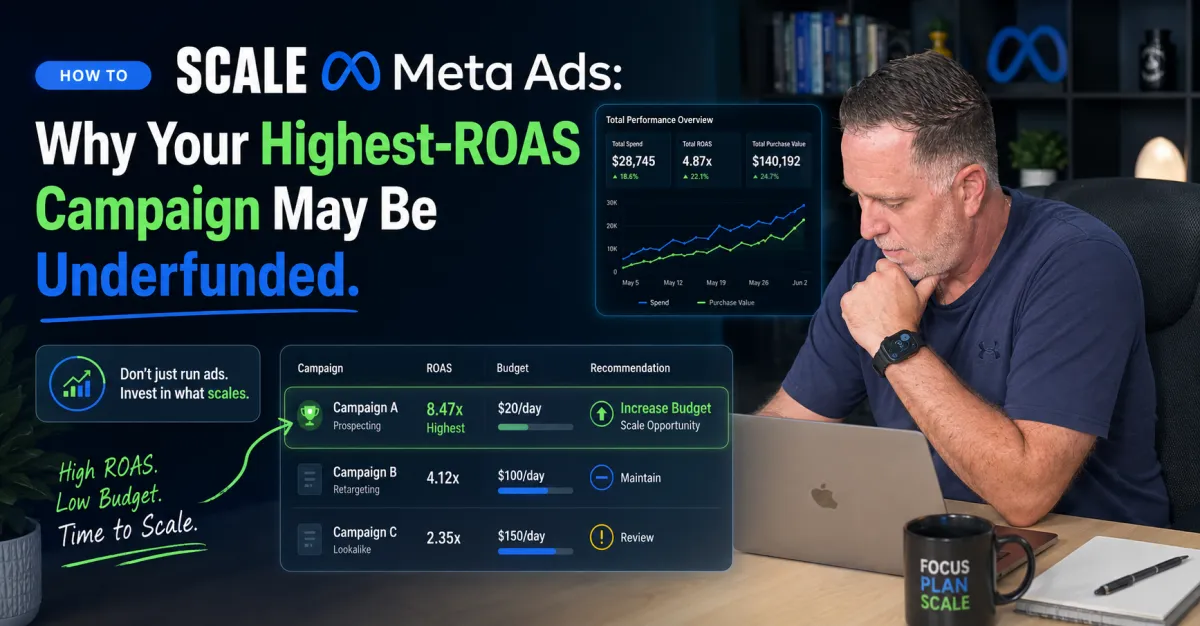
How to Scale Meta Ads: Why Your Highest-ROAS Campaign May Be Underfunded
We were reviewing an ad account recently where the retargeting campaign had the best ROAS on the dashboard by a wide margin.
It had generated $2,751 in sales from $207.97 in ad spend, which worked out to roughly 13.23x ROAS.
The obvious question was a good one: why was the best-performing campaign getting so little money?
That is where paid social gets more interesting than the dashboard makes it look. A 13.23x return tells us that the campaign was extremely efficient at that level of spend, with that audience, during that period. It gives us very little information about what happens when we ask the campaign to spend another $100, $500, or $1,000.
That next-dollar question is the one we care about when we talk about how to scale Meta ads.
ROAS tells you what already happened
Shopify defines ROAS as the revenue attributed to advertising divided by the advertising cost.
That makes ROAS useful because it lets you compare efficiency across campaigns. If one campaign produces $5 for every $1 spent and another produces $2, the first campaign clearly created more revenue per advertising dollar at those spend levels.
The limitation shows up when we start making budget decisions.
A high average ROAS does not tell us how much additional demand remains available inside the audience. It does not show how the campaign will behave after spend increases. It also does not tell us whether the campaign deserves all of the revenue credit appearing in the platform.
That is why we treat ROAS as one decision input rather than the final answer.
Why retargeting campaigns often have the highest ROAS
Retargeting usually reaches people who already know something about the business.
They may have visited the website, viewed a product, engaged with social content, started checkout, joined a list, or interacted with the company in another measurable way. Meta allows advertisers to build Custom Audiences from website activity, along with other first-party and engagement signals.
Those people naturally sit closer to a buying decision than someone seeing the brand for the first time.
That is why a retargeting campaign can look incredible on the dashboard while spending a relatively small amount of money. It is working with a warmer and usually smaller pool of people.
The challenge begins when we assume that the same efficiency will continue indefinitely as the budget grows.
The real scaling question is what the next dollar can produce
Take the account we were reviewing.
The current retargeting campaign looked like this:
Ad spend: $207.97
ROAS: 13.23x
Revenue: $2,751
Now imagine a controlled scale test where the campaign spends $500 and settles at an 8.0x ROAS.
The result would look like this:
Ad spend: $500
ROAS: 8.0x
Revenue: $4,000
The ROAS fell significantly, while revenue increased by $1,249.
That does not automatically prove that the second scenario produced more profit. You still have to account for margins, cost of goods, fulfillment, payment fees, returns, discounts, and any other variable costs attached to those additional sales.
It does show why protecting the prettiest ROAS number can become expensive.
The better question is whether the additional spend can generate additional sales while keeping the campaign above the return your business needs.
Know your profitable floor before you increase the budget
Every business should know the point where another sale stops making financial sense.
For ecommerce, this usually starts with contribution margin. If you sell $100 of product and retain roughly $40 after the variable costs attached to fulfilling that order, your contribution margin is 40%.
A simplified break-even ROAS calculation would be:
Break-even ROAS = 1 ÷ contribution margin
At a 40% contribution margin, the simplified break-even ROAS would be 2.5x.
That does not mean 2.5x automatically becomes your target. The business may still need room for overhead, agency costs, refunds, salaries, software, cash-flow requirements, and profit.
The calculation gives you a floor to work from.
Shopify’s current PPC budgeting guidance makes the same broader point: ad budgets should connect to customer acquisition cost, conversion rate, lifetime value, margins, and the financial outcome the business actually needs.
Once you know that threshold, an 8x campaign may still have enormous room to scale even though it looks less efficient than the 13.23x version.
Question 1: How large and fresh is the retargeting audience?
A retargeting campaign needs people entering the pool.
If you have 20,000 qualified visitors arriving every week, the campaign has a different scaling opportunity than an account getting a few hundred visitors each month.
This is one reason the relationship between prospecting and retargeting matters so much. Cold campaigns, organic content, search, email acquisition, partnerships, and other traffic sources keep introducing new people to the business. Retargeting works with the portion that becomes warm enough to qualify for the audience.
If the top of the funnel slows down, the retargeting pool eventually feels it.
We look at how many qualified people are entering the audience, which behaviors qualify them, how long they remain eligible, and whether that pool is continuing to replenish as spend increases.
We also watch frequency. Meta defines frequency as the average number of times each person sees an ad. When spend grows much faster than audience supply, the campaign can begin showing ads to the same people more often.
Higher frequency does not automatically mean the campaign has a problem. It gives us another piece of context about whether additional budget is creating new opportunity or repeatedly buying access to the same opportunity.
Question 2: What return does the business actually need?
This is where marketing metrics have to connect back to the P&L.
A founder sees 13.23x ROAS and naturally wants to preserve it because it feels safe. We would rather know the lowest acceptable return that still supports the economics of the business.
That threshold changes by company.
A high-margin digital product may tolerate a very different acquisition cost from a physical product with expensive shipping and fulfillment. A subscription brand may accept lower first-order efficiency because strong retention creates additional value later. A company struggling with cash flow may need a higher immediate return even when lifetime value looks attractive.
There is no universal “good ROAS.”
Shopify’s current ROAS guide makes that clear as well: acceptable performance depends on margins, operating costs, and advertising goals.
The useful number is the return that your business can sustain profitably while still supporting the growth you want.
Question 3: What are you going to measure after the scale test?
If you increase a campaign budget and only watch ROAS, you leave too much of the story out.
We would normally track:
additional ad spend
incremental purchases or qualified leads
additional revenue
cost per purchase or qualified lead
ROAS
customer acquisition cost
conversion rate
frequency
new versus returning customer mix where relevant
total account revenue and efficiency
actual contribution after variable costs
That gives you a much clearer read on what happened.
Suppose ROAS falls from 13.23x to 9x, purchases increase meaningfully, contribution profit grows, and the account still sits far above its financial floor. We would have a very different reaction than we would if ROAS fell because frequency jumped, conversion rate collapsed, and additional spend created almost no additional orders.
The number moved in both cases. The business outcome tells us what the move meant.
If you want the broader framework we use to connect traffic, conversion, and revenue decisions like this, our free guide and training lays out how we think about finding the highest-leverage point in the growth system before adding more activity.
Question 4: Is the retargeting campaign earning all the credit it reports?
This is one of the biggest gaps in a dashboard-only analysis.
Retargeting reaches people who already interacted with the business, which means several marketing touchpoints may have contributed to the purchase before Meta reports the conversion.
Someone might discover the brand through organic social, visit from Google, receive an email, click a retargeting ad, and finally purchase.
Meta Ads Manager lets advertisers use and compare different attribution settings, including different click-through and view-through windows. Changing the window can change the number of conversions associated with a campaign.
That does not make the data useless. It means we need to understand what the data represents.
We want to know how much credit the campaign receives from clicks, how much comes from view-through attribution, and how the reported result compares with the store, CRM, analytics, and broader account performance.
A campaign can look dramatically stronger when it sits at the end of a customer journey that other channels helped create.
Make sure the Meta Pixel and Conversions API are giving you useful data
Scaling decisions get harder when tracking is incomplete.
The Meta Pixel can capture website actions and help build audiences from visitor behavior. Meta’s Conversions API provides another way to send customer events into Meta and support measurement, optimization, and audience creation.
We want those systems working together cleanly where appropriate.
Before we trust a high ROAS enough to add more budget, we check whether the important events are firing correctly, whether purchases carry the correct values, whether duplicate events are being handled properly, and whether the campaign is optimizing toward actions that actually matter to the business.
A clean dashboard built on weak tracking can still lead to a bad budget decision.
Check whether the landing page is helping the campaign earn that return
The work continues after the click.
Retargeting may bring back someone with genuine buying intent, yet the landing page still has to finish the job. If the message changes, the offer becomes confusing, mobile usability falls apart, or checkout creates unnecessary friction, increasing the advertising budget simply exposes more people to that weak point.
That is why we look at the landing-page destination when we audit Meta accounts.
A campaign with a strong ROAS may have even more room to scale after the conversion path improves. A campaign that already struggles to turn warm traffic into sales may need web work before additional spend becomes the priority.
Paid social and CRO belong in the same conversation because every advertising dollar eventually lands somewhere.
Scaling should be a controlled test
There is another reason we avoid large, impulsive budget changes.
Meta says some significant campaign edits can cause ad sets to re-enter the learning phase. Budget changes can be part of that depending on the campaign setup, including campaigns using Advantage+ campaign budget.
That does not mean budgets should stay frozen. It means we want to make deliberate changes and give the system enough room to show us what those changes actually did.
We would rather test an increase, document the starting numbers, and review the new result after enough conversion data has accumulated than keep moving the budget every time yesterday’s ROAS looks different.
The process should answer one question at a time.
Did the extra budget create enough additional value to justify the lower efficiency?
That is much easier to answer when the rest of the account stays reasonably stable during the test.
Your highest-ROAS campaign may depend on the campaigns with lower ROAS
This is the part that gets missed when every campaign gets judged independently.
A retargeting campaign cannot keep selling to warm people unless something keeps creating warm people.
Your prospecting campaigns may carry a lower direct ROAS because they are introducing the brand to buyers who have never interacted with it. Those campaigns can also feed website visitor audiences, engagement audiences, product viewers, email signups, and other groups that later convert through retargeting.
If you starve acquisition because retargeting looks better on the dashboard, you can eventually shrink the very audience that made retargeting perform so well.
This is why we look at account structure as a system.
Some campaigns create demand. Some capture demand. Some bring people back. The budget decision has to account for how those pieces support each other.
A lower ROAS can still be the healthier business decision
The goal of scaling is not preserving maximum efficiency at minimum spend.
The goal is finding the point where the business can generate the most useful volume while staying inside its financial requirements.
There will usually be a tradeoff as spend rises. The easiest buyers convert first. Additional spend may reach people who need more convincing, creative may work harder, frequency may rise, and the average return may come down.
That can still be a very good outcome.
Imagine you could choose between these two monthly scenarios:
Campaign A generates $10,000 in revenue from $500 in spend at 20x ROAS.
Campaign B generates $80,000 in revenue from $10,000 in spend at 8x ROAS.
The first campaign looks better in a screenshot. The second may create far more actual business value if the margins support it.
This is why our question stays focused on the next dollar.
When we would hesitate to add more retargeting budget
A high ROAS earns our attention. We still want evidence that the campaign has room to absorb more spend.
We become more cautious when the retargeting audience is barely growing, frequency is climbing quickly, the same creative has been carrying the account for too long, conversion rate is weakening, attribution appears heavily influenced by view-through credit, or the additional orders would fall too close to the business’s financial floor.
We would also look at inventory and operational capacity. Scaling a campaign that sells low-margin products, creates fulfillment problems, or pushes the company into stockouts can create revenue while making the business harder to operate.
The campaign lives inside the business. The business economics get the final vote.
Why the prettiest ROAS can become a vanity metric
Owners usually do not chase ROAS because they are obsessed with a dashboard. They chase it because high efficiency feels like proof that the account is safe.
We understand the instinct.
The problem starts when maintaining the ratio becomes more important than discovering how much profitable demand the business can actually capture.
A campaign that spends $200 at 13x may have significant room left. It may also be fully saturated. You cannot know from the 13x alone.
You have to inspect the audience, the economics, the measurement, the conversion path, and what happens when the budget changes.
That turns ROAS from a scoreboard into a decision tool.
What our Meta & Social Ad Account Audit looks for
This exact question is one of the reasons we built our free Meta & Social Ad Account Audit.
We review campaign structure, cold and warm audience segmentation, creative-to-audience fit, ROAS and budget allocation, landing-page destinations, and Meta Pixel and tracking setup.
We are trying to answer the questions the dashboard leaves open.
Which campaign actually has room to take more budget?
Where is the account spending without producing enough value?
Is retargeting carrying the account because the warm audience is genuinely strong, or because attribution is giving it more credit than the business realizes?
Does prospecting need more support so the warm pool keeps growing?
Should we fix the landing page before adding another dollar?
Within 48–72 hours, you receive a private written breakdown of the three biggest issues we find and the actions we would prioritize first.
Frequently asked questions about scaling Meta ads
Should I scale the campaign with the highest ROAS?
A high ROAS is a good reason to investigate a campaign’s scaling potential. Review the audience size, frequency, financial floor, attribution, tracking, conversion rate, and additional revenue potential before increasing the budget.
What is a good ROAS for Meta ads?
A useful ROAS depends on your margins, operating costs, customer lifetime value, cash-flow needs, and growth goals. A number that works for a high-margin subscription company may be unprofitable for a physical-product business with expensive fulfillment.
How much should I increase my Meta ads budget?
There is no universal percentage that fits every account. The appropriate change depends on current spend, conversion volume, campaign structure, audience size, learning status, and how much financial risk the business can tolerate. Controlled tests give you a cleaner read than large reactive jumps.
Why did ROAS drop after I increased my Meta ads budget?
Additional spend can expose the campaign to a wider portion of the available audience, increase frequency, change delivery patterns, or simply reach buyers with lower immediate purchase intent. Review whether the additional spend still created profitable incremental purchases before treating the lower ROAS as a failure.
Can retargeting campaigns scale indefinitely?
Retargeting depends on the size and freshness of the warm audience feeding the campaign. Growth usually becomes harder when the business adds budget faster than new qualified people enter that pool.
How do I know whether Meta deserves credit for a sale?
Review your attribution settings, compare click-through and view-through reporting, confirm Pixel and Conversions API tracking, and compare Meta reporting with your store, CRM, and analytics data. This gives you a more complete picture of how the customer reached the purchase.
Scale toward profit instead of protecting a dashboard number
The 13.23x campaign that started this conversation may deserve more budget.
The dashboard alone cannot make that decision.
We need to know whether fresh people are entering the audience, how frequently the existing audience is seeing the ads, what return the business can afford, whether tracking is clean, how much revenue the campaign is genuinely influencing, and what happens to total profit when another dollar enters the system.
Once those pieces are clear, scaling becomes a measured business decision instead of a guess.
Start with our free guide and training if you want the broader framework we use to find leverage across traffic, conversion, and growth. If your Meta account is already running and you want to know which campaigns can profitably take more budget, request your free Meta & Social Ad Account Audit.
