
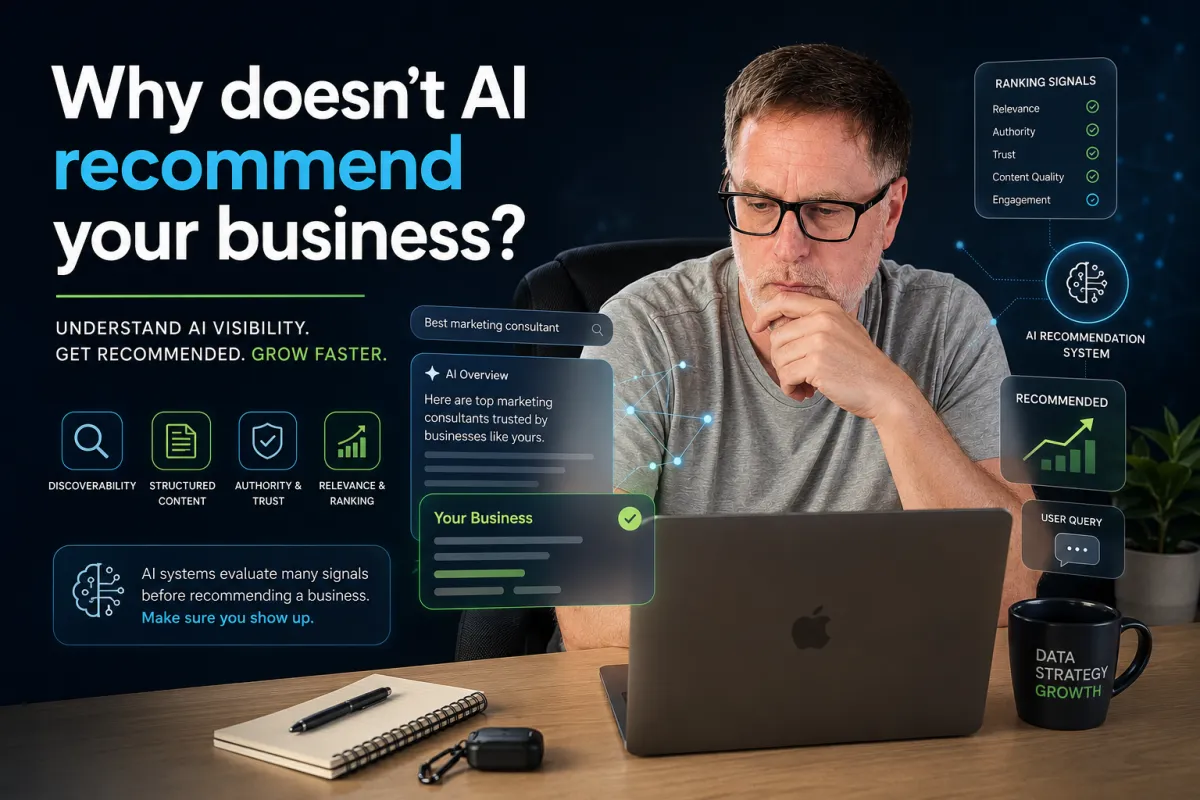
AI Search Visibility: Why AI Doesn’t Recommend Your Business
Business owners are starting to notice a new kind of visibility gap. Their company may appear when someone searches its name, yet disappear when a buyer asks ChatGPT or a Google AI experience to recommend providers in the category.
The usual reason is fairly practical. The public web does not give these systems enough clear, accessible, and consistent evidence about what the business does, who it serves, where it operates, and why someone should consider it credible.
AI search visibility builds on the same foundation that has always helped search engines understand a business. Your website needs a clear technical structure. Your positioning needs to stay consistent. Your service and product information needs to be specific. Your public profiles, reviews, and supporting content need to reinforce the same story.
When those pieces disagree or remain underdeveloped, an AI system has less confidence connecting your business to the buyer’s question.
What AI search visibility actually means
AI search visibility describes how accurately and frequently your business appears in AI-generated answers, summaries, comparisons, and recommendations.
A buyer might ask:
Who are the best Shopify marketing agencies for an established ecommerce brand?
Which local web development companies specialize in healthcare?
What firms help small businesses improve Google Ads conversion rates?
Which consultants can help a business build a predictable sales system?
What are the best options for a specific product or service near me?
Traditional search usually responds with ranked pages, map results, products, and advertisements. AI-generated search experiences can assemble an answer from multiple sources and present a smaller set of options directly inside the response.
That changes the way a buyer encounters your business, but the underlying work remains familiar. Google’s current guide to optimizing for generative AI search describes answer engine optimization and generative engine optimization as extensions of SEO rather than separate technical disciplines.
The foundation still comes down to whether search systems can access your information, understand it, and find enough reason to surface it.
AI cannot clearly describe a business that describes itself vaguely
A lot of business websites say some version of the same thing.
They deliver innovative solutions. They create meaningful results. They offer personalized service. They help businesses grow.
Those statements sound positive, but they provide very little information that a search engine or prospective customer can use to distinguish one company from another.
Clear positioning gives the web something more useful to work with. Your website should explain:
what you sell
who you sell it to
which problems you solve
where you operate
which industries or situations you understand best
what evidence supports your claims
how someone can take the next step
Consider the difference between “We help businesses grow through digital marketing” and “We help established ecommerce brands improve paid-media efficiency by fixing the conversion leaks between their ads, website, email, and sales process.”
The second description gives both the buyer and the search system a clearer category, customer, problem, and method.
This clarity needs to appear across your homepage, service pages, title tags, headings, business profiles, social profiles, directory listings, and third-party descriptions. Repetition should reinforce the business accurately rather than copy the same paragraph everywhere.
Make sure AI search systems can access the website
Strong positioning only helps when the site can be crawled and indexed.
OpenAI says any public website can appear in ChatGPT search. Its publisher guidance recommends allowing OAI-SearchBot to access pages so ChatGPT can discover, summarize, cite, and link to the content.
Google gives similar guidance for its AI search experiences. Its AI features documentation recommends making sure crawling is permitted through the site’s robots.txt file, content delivery network, and hosting infrastructure. It also recommends using internal links, keeping important information available as text, and maintaining a strong page experience.
A visibility review should therefore check for problems such as:
important pages blocked from crawling
accidental noindex directives
broken internal links
pages missing from the XML sitemap
content hidden behind scripts that fail to load
duplicate or competing service pages
thin pages with little useful information
weak mobile performance
outdated canonical tags or redirects
These issues can prevent a strong business from becoming a clear search result because the systems cannot reliably access or interpret the evidence.
Keep your business information consistent across the web
Your website is one source of information about the company. Search systems can also encounter your business through public profiles, directories, reviews, articles, social pages, association listings, interviews, videos, and other websites.
The details should agree.
For a local or regional business, that includes the company name, primary category, address or service area, phone number, website, hours, services, and business description. For an ecommerce or online company, consistency may center more heavily on brand name, product categories, audience, founder information, service descriptions, and industry positioning.
Google says local visibility relies mainly on relevance, distance, and prominence. Its local ranking guidance recommends providing complete and detailed Business Profile information so Google can understand the business and match it to appropriate searches. Google also identifies links, reviews, and positive ratings as signals related to prominence.
This does not mean every directory listing creates instant visibility. It means a consistent public footprint gives search systems fewer contradictions to resolve.
When your website calls the company an ecommerce growth partner, the Business Profile categorizes it as a web designer, LinkedIn presents it as a general consulting firm, and directory listings contain old contact details, the overall identity becomes harder to interpret.
Use structured data as clarification, not as a shortcut
Structured data gives search engines explicit information about the meaning of a page. Depending on the business and page type, that may include details about the organization, local business, products, articles, events, videos, people, or frequently asked questions.
Google’s structured data documentation explains that this standardized markup can help Google understand the people, companies, products, and other entities included on a page. Its LocalBusiness structured data guide provides a framework for identifying details such as business hours, departments, and other local information.
Structured data should match the content a visitor can see on the page. It works best as a clean label on accurate information rather than an attempt to manufacture relevance that the page itself has not earned.
Google also states that businesses do not need special AI schema, AI text files, or unique machine-readable markup to appear in its generative search features. Standard, correctly implemented SEO remains the practical priority.
Create content that proves what you know
A business becomes easier to recommend when it publishes evidence of real competence.
Generic content teaches broad concepts anyone could find elsewhere. Stronger content reflects first-hand experience and answers the questions a serious buyer asks while evaluating options.
That could include:
detailed service explanations
case studies with specific context and numbers
process breakdowns
comparisons between realistic options
honest explanations of who the service fits
examples of common problems found during audits
frequently asked sales questions
original research or internal observations
before-and-after analyses
commentary from the people doing the work
The goal is to create a body of information that makes your expertise visible before a buyer speaks with you.
For example, a page that says “we provide Google Ads management” establishes a service category. A series of useful resources explaining how your team evaluates bidding strategy, search-term quality, landing-page friction, conversion tracking, and sales follow-up gives that category depth.
That depth helps prospective customers validate the business and gives search systems more specific material to retrieve, summarize, and cite.
Our free guide and training explains the broader framework we use to connect visibility, conversion, campaigns, and revenue so owners can see which part of their growth system deserves attention first.
Strengthen the evidence beyond your own website
Every business describes itself positively. Third-party evidence provides additional context.
That evidence can come from legitimate customer reviews, local and industry directories, professional associations, podcast appearances, interviews, supplier profiles, partner websites, news coverage, community involvement, and expert contributions to reputable publications.
The strongest mentions usually happen because the company has done something worth referencing. It delivered a measurable result, shared useful expertise, supported an organization, created original research, built a partnership, or became known for a specific capability.
Google’s generative AI guidance warns businesses against chasing inauthentic mentions. Its systems can use information from blogs, videos, forums, and other public sources, while quality and spam systems still evaluate those sources.
That makes earned relevance more valuable than manufactured volume.
A few accurate mentions that strongly reinforce your category and expertise can provide more useful context than dozens of low-quality listings created only for a link.
Reviews help establish category relevance and trust
Reviews do more than raise an average star rating. They reveal how customers describe the company, which services they associate with it, and which outcomes stood out.
A review that says “great company” offers limited context. A review explaining that the team improved a Shopify checkout, rebuilt a Google Ads account, or helped a seven-person company install a clearer sales process gives prospective customers and search systems more specific information.
Businesses should never script or manipulate customer reviews. They can make it easier for customers to leave honest feedback and ask them to describe the service and experience in their own words.
The same principle applies when responding to reviews. A thoughtful response can confirm the context, acknowledge the work, and reinforce the company’s standards without stuffing keywords into the conversation.
Traditional SEO and AI visibility support each other
The original email makes an important point: a weak traditional search foundation usually limits AI search visibility too.
Google’s current guidance supports that connection directly. Pages need to meet Search technical requirements and remain eligible for indexing before they can appear in Google’s generative AI features. Google also recommends the same foundational work for both experiences: crawlable pages, strong internal linking, useful text, updated business data, good page experience, and valuable original content.
That does not mean ranking first for one keyword guarantees a recommendation in every AI answer. Different prompts can produce different results, and each platform uses its own systems and available sources.
It means the work that makes a business easier to find, understand, and trust in traditional search also creates a stronger foundation for emerging discovery channels.
SEO still matters because it organizes the public evidence around the business.
Traditional rank tracking only tells part of the story
Keyword rankings remain useful. They show whether pages are gaining visibility for searches that matter to the business.
AI-generated results create additional questions:
Does the system mention the company?
Does it describe the company accurately?
Which services or categories does it associate with the brand?
Which competitors appear when the company does not?
Which sources does the response cite?
Does the business appear for broad discovery questions or only branded prompts?
Google began rolling out dedicated generative AI performance reports in Search Console in June 2026. These reports can show impressions, pages, countries, devices, and dates associated with visibility in Google’s generative search features, although Google initially limited the rollout to a subset of websites.
For ChatGPT search, OpenAI adds utm_source=chatgpt.com to referral links, which means businesses can identify some inbound ChatGPT traffic in analytics when users click through.
Neither view tells the entire story. A business can appear in an answer without receiving a click, and an inaccurate description may matter even when traffic remains low. That is why measurement should combine analytics, Search Console, traditional rankings, local visibility, and manual testing of realistic buyer questions.
Test the questions customers actually ask
The quality of an AI visibility check depends heavily on the prompts being tested.
Searching only for your exact company name answers whether the system recognizes the brand. It does not tell you whether the business appears during discovery.
Build a prompt set around actual buying situations, such as:
best providers for a specific service
companies serving a particular industry
options in a specific city or region
providers for a defined budget or business size
comparisons between service approaches
recommendations for a specific business problem
alternatives to a known competitor
specialists for a particular platform or technology
Run several variations and record whether the company appears, how it is described, which competitors appear, and which sources support the answer.
Treat the results as directional evidence rather than a permanent ranking. The purpose is to identify patterns and information gaps that deserve attention.
Fix the clearest visibility gaps first
AI search visibility can sound like one more complicated marketing initiative, especially for a small team that already has a full workload.
The practical approach is to work in sequence.
Start with technical access. Confirm that search crawlers can reach and index the important pages.
Then clarify positioning. Make the customer, category, service, problem, and location easy to understand.
Align the public profiles. Correct outdated descriptions, categories, contact information, and service details.
Improve the content. Build pages and resources that answer serious buyer questions with first-hand detail.
Strengthen legitimate third-party proof. Encourage honest reviews and pursue credible mentions through real work and relationships.
Measure the results. Track traditional visibility, local performance, AI referrals, mentions, description accuracy, and cited sources.
This sequence gives the business a cleaner foundation and avoids wasting time on every new AI optimization tactic that appears online.
What our SEO Visibility Report looks for
Before trying to influence how an AI system describes the business, you need a clearer view of what search engines can currently find and understand.
Our free SEO Visibility Report reviews the public signals supporting your search presence, including technical health, keyword gaps, authority indicators, and local visibility where relevant. A strategist then reviews the findings and identifies the highest-priority issues that deserve attention first.
The purpose is to replace a generic SEO checklist with a prioritized diagnosis.
You may discover that the largest problem is technical. You may find that the site ranks for broad information but lacks clear commercial pages. The business profile may use the wrong category. The website may describe the offer differently on every page. Competitors may have stronger proof and more complete category coverage.
Once you know which issue carries the most leverage, the work becomes much easier to sequence.
Frequently asked questions about AI search visibility
How do I get my business recommended by ChatGPT?
Start by making sure OAI-SearchBot can access your public website. Then clarify what your business does, publish useful content around real buyer questions, build credible third-party evidence, and keep your public business information consistent. No tactic can guarantee a recommendation, but these steps give ChatGPT search more accessible and relevant information to work with.
Is AI SEO different from traditional SEO?
The terminology is different, but much of the work overlaps. Google says optimization for its generative AI search features still relies on foundational SEO, including crawlability, useful original content, internal links, page experience, structured data accuracy, and current business information.
Do I need special schema for AI search?
Google says there is no special schema.org markup required for its generative AI features. Standard structured data can still help search systems understand page content and make pages eligible for relevant rich results.
Does a high Google ranking guarantee AI visibility?
A strong search presence improves the foundation, but it does not guarantee that a business will appear in every generated answer. AI visibility can vary based on the question, location, context, available sources, and the system producing the response.
How can I measure whether AI systems mention my business?
Use a combination of realistic prompt testing, Google Search Console, referral traffic carrying ChatGPT’s source tag, local visibility reporting, and traditional SEO data. Track whether the brand appears, how accurately it is described, which competitors appear, and which sources support the answer.
Give search systems a clear business to understand
AI discovery adds a new surface to the buying journey. It does not remove the need for a clear offer, a technically healthy website, consistent business information, credible proof, and useful content.
Those are the signals that help customers understand you, and they also give search systems stronger evidence when they assemble an answer.
Before looking for an AI visibility hack, find out whether the public web can clearly explain what your business does today.
Request your free SEO Visibility Report to see where your technical health, keyword coverage, authority signals, local presence, and business positioning may be limiting discovery.
