
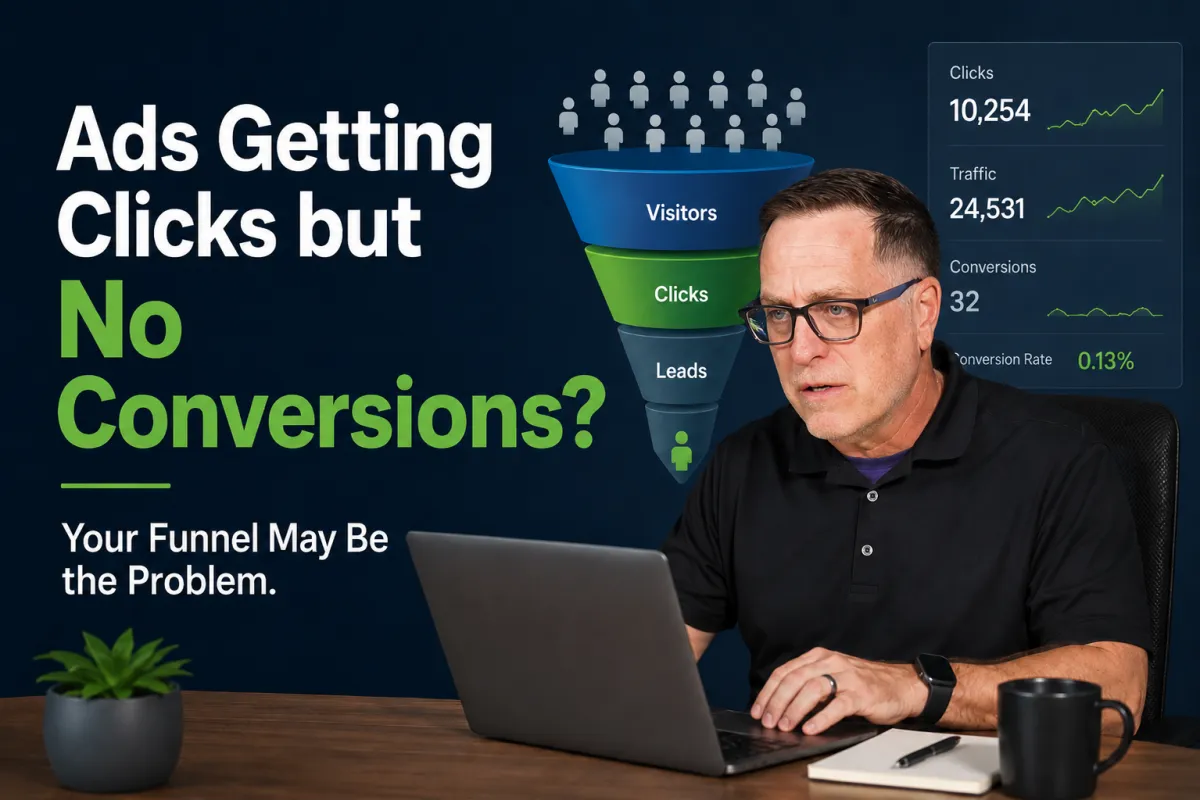
Ads Getting Clicks but No Conversions? Your Funnel May Be the Problem
Clicks can make an ad account look healthier than the business feels.
The cost per click looks reasonable. The campaign is spending. Google reports activity. People are reaching the website. Then the leads fail to come through, sales stay flat, and the natural reaction is to start rewriting ads or changing bids.
Sometimes the campaign needs work. In plenty of accounts, the ad already completed its first job by earning the visit. The breakdown happens during one of the handoffs that follows.
The landing page has to turn that visit into real interest. The form or checkout has to convert interest into action. The follow-up system has to keep the conversation moving. The sales process has to close the opportunity. A weakness at any one of those stages can make a productive campaign look like a bad one.
That is why ads getting clicks but no conversions usually calls for a full-funnel diagnosis instead of another isolated campaign change.
A click is only the first handoff
An ad creates an opportunity. It does not carry the entire sale.
Once someone clicks, the business still has to answer several questions quickly. Did the visitor reach the page they expected? Does the offer make sense? Can they tell who it is for? Is the next step clear? Does the page give them enough confidence to continue?
Google’s landing-page guidance connects these pieces directly. Google recommends matching the page closely to the ad and keywords, mirroring the call to action, making the site mobile-friendly, and helping visitors complete the desired action without unnecessary searching.
That is the bridge between campaign performance and business performance.
A strong click sent into a confusing experience still becomes wasted spend. A relevant visitor who encounters a weak form, vague offer, or clumsy checkout may leave even though the targeting worked.
Confirm the tracking before diagnosing the funnel
Before changing the landing page or rebuilding the campaign, confirm that the business can see conversions accurately.
This is a basic step, but it gets skipped more often than it should. A form can submit successfully while Google Ads records nothing. A Shopify order can come through while the advertising platform misses the purchase. A phone call can become a qualified lead without getting attributed to the campaign that generated it.
Google’s web conversion measurement guidance explains that conversion tracking measures the actions people take after interacting with an ad. Those actions can include purchases, form submissions, calls, and other events the business considers valuable.
We would test the full path ourselves before making larger strategic decisions. Submit the form. Complete a test checkout when practical. Click the phone number. Confirm the event appears in analytics and the advertising platform.
A broken measurement setup can make a healthy funnel look empty. Clean tracking gives every decision that follows a better foundation.
Map the journey from traffic source to closed sale
Once tracking is working, map the entire path a customer takes.
For a lead-generation business, that path may look like this:
Ad click → landing page → form submission → follow-up → booked call → attended call → closed client
For ecommerce, the journey may look more like this:
Ad click → product or collection page → product evaluation → cart → checkout → purchase → repeat purchase
This map does not need to become a complicated diagram. It needs to show where people move forward and where they disappear.
Most teams look at the beginning and the end. They know how many clicks came in and how many sales came out. The middle stays blurry, which makes every performance conversation harder than it needs to be.
Our free guide and training walks through the broader Revenue Roadmap we use to identify the point of greatest leverage before adding more activity. The practical goal is to find the stage that is restricting the rest of the system and fix that stage first.
Check whether the traffic fits the offer
A landing page cannot rescue every visitor.
The first question is whether the campaign is attracting people with a realistic reason to convert. High click volume can create confidence, but clicks from low-intent or irrelevant searches only make the account look busy.
For Google Search campaigns, review the actual queries inside the search terms report. The report shows which searches triggered the ads, and Google recommends adding irrelevant terms as negative keywords so the campaign stops appearing for people looking for something the business does not sell.
Look beyond the headline numbers and ask whether the searches reflect buying intent.
A business selling premium commercial services may get traffic from people looking for free templates, entry-level jobs, definitions, or do-it-yourself instructions. Those visitors can click a relevant-looking ad while remaining poor candidates for the actual offer.
Traffic quality shapes every conversion metric downstream. Cleaning it up gives the landing page a fairer test.
Check the promise-to-page connection
Once the traffic looks relevant, review what happens immediately after the click.
The ad establishes an expectation. The landing page has to continue that same conversation. When the message changes abruptly, visitors have to stop and figure out whether they arrived in the right place.
Suppose the ad promises a specific service, outcome, or free resource. The page should surface that promise quickly. The visitor should not have to scroll through a general company introduction, navigate to another page, or interpret broad language before finding what they came for.
A strong promise-to-page connection usually includes:
a headline that reflects the ad’s core message
a clear explanation of the offer
proof that fits the claim
a visible next step
enough context to reduce the most likely objection
This is also where mobile experience matters. A page that feels clean on a desktop monitor can become slow, cramped, or difficult to navigate on a phone. Google recommends keeping mobile pages fast and making contact or conversion actions easy to complete.
Look at engagement before assuming the visitor had no interest
GA4 can help show whether people are giving the page a real chance.
Google defines an engaged session as one that lasts longer than 10 seconds, records a key event, or includes at least two page or screen views. Its engagement-rate and bounce-rate guidance gives businesses a better way to evaluate whether traffic is interacting meaningfully after the click.
A high bounce rate on one landing page does not automatically explain the entire problem. It does give you a place to investigate.
Compare engagement by campaign, device, landing page, and traffic source. A page may perform acceptably for desktop organic visitors and poorly for mobile ad traffic. One campaign may send people who explore the site, while another produces short sessions with no meaningful actions.
Those differences help narrow the diagnosis.
Find the friction in the lead capture or checkout
Sometimes the visitor understands the offer and still stops at the conversion point.
For lead generation, inspect the form closely. Consider how much information you are asking for, whether the request feels appropriate for the value offered, and whether the page explains what happens after submission.
For ecommerce, review the product, cart, and checkout experience as one connected path. Baymard Institute’s checkout research tracks an average cart abandonment rate of roughly 70%, showing how much intent can disappear late in the journey. Baymard also estimates that large ecommerce sites can improve conversion substantially by addressing solvable checkout usability issues.
The broader point is straightforward: demand can exist while friction prevents the sale.
Look for unnecessary form fields, surprise costs, unclear shipping information, weak trust signals, poor error messages, limited payment options, and distractions that pull people away from the action.
Small points of friction become expensive when every paid visitor encounters them.
Inspect what happens after the lead comes in
A funnel can leak after the form submission too.
The ad may attract the right person. The page may convert them. The lead may enter the CRM. Then the response arrives too late, the follow-up feels generic, or nobody owns the next step clearly.
That creates a reporting problem as well as a sales problem. Marketing sees a conversion. Sales sees a weak opportunity. Leadership sees revenue that never appeared.
A useful funnel review should follow the lead through the rest of the process. Look at how quickly the first response happens, whether the message matches what the prospect requested, how appointments get scheduled, how no-shows get handled, and how long-term prospects get nurtured.
The advertising platform cannot repair a broken handoff between marketing and sales.
Check whether the campaign has been managed since launch
The uploaded document describes another pattern we see often: a campaign starts reasonably well, then performance declines while the account remains untouched.
A campaign is not a slow cooker. Launching it and leaving it alone rarely creates a durable growth system.
Google Ads provides a change history report that shows account changes over the previous two years. It can help you connect performance shifts to bid changes, budget adjustments, keyword edits, new ads, and other updates. It also makes inactivity easy to spot.
Review whether anyone has:
refined search terms and negative keywords
tested new ad messaging
adjusted budgets around performance
reviewed landing-page data
checked conversion tracking
responded to changes in customer behavior
Campaign management requires iteration. The same setup can lose relevance as search behavior, competition, creative response, and conversion patterns change.
Fix one constraint before changing six things
When several parts of the funnel look weak, teams often try to repair everything at once. That creates motion while making the results harder to interpret.
We prefer to identify the biggest current constraint and work through it in sequence.
A 90-day operating window can help here. The business can choose one core growth system, establish the measurement, implement the change, and give the work enough time to produce a useful pattern. That approach creates clearer learning than changing the targeting, offer, landing page, follow-up, and sales script at the same time.
The first priority may be tracking. The next may be traffic quality. After that, the page or the follow-up process may deserve attention. The order depends on where the evidence points.
This is how the funnel becomes easier to manage. Each improvement makes the traffic entering the system more valuable.
What to do when your ads get clicks but no conversions
Start by resisting the urge to make the ad account carry the entire diagnosis.
Confirm that conversions are tracked correctly. Review the actual traffic entering the campaign. Check whether the landing page continues the promise made by the ad. Inspect engagement, lead capture, checkout, nurture, and the sales handoff. Then review the campaign’s change history to see whether anyone has actively managed it since launch.
The goal is to locate the leak before spending more money through it.
A campaign can generate perfectly reasonable clicks while the surrounding system struggles to turn those clicks into revenue. Once you know which handoff is failing, the next decision becomes much clearer.
For the broader framework we use to map these systems and identify the point of greatest leverage, start with our free guide and training. For a closer review of where traffic is dropping out of your current funnel, book a call with us.
